
Adam Zamoyski first wrote his history of Poland two years before the collapse of the Soviet Union. This substantially revised and updated edition sets the Soviet era in the context of the rise, fall and remarkable rebirth of an indomitable nation. In 1797, Russia, Prussia and Austria divided Poland among themselves, rewriting Polish history to show that they had brought much-needed civilisation to a primitive backwater. But the country they wiped off the map had been one of Europe's largest and most richly varied, born of diverse cultural traditions and one of the boldest constitutional experiments ever attempted. Its destruction ultimately led to two world wars and the Cold War. Zamoyski's fully revised history of Poland looks back over a thousand years of turmoil and triumph, chronicling how Poland has been restored at last to its rightful place in Europe.
POLAND A HISTORYADAM ZAMOYSKI
Copyright
HarperPress
An imprint of HarperCollins
1 London Bridge Street
London SE1 9GF
http://www.harpercollins.co.uk
Published by HarperPress 2009
FISRT EDITION
Copyright © Adam Zamoyski Ltd 2009
Adam Zamoyski asserts the moral right to be identified as the author of this work
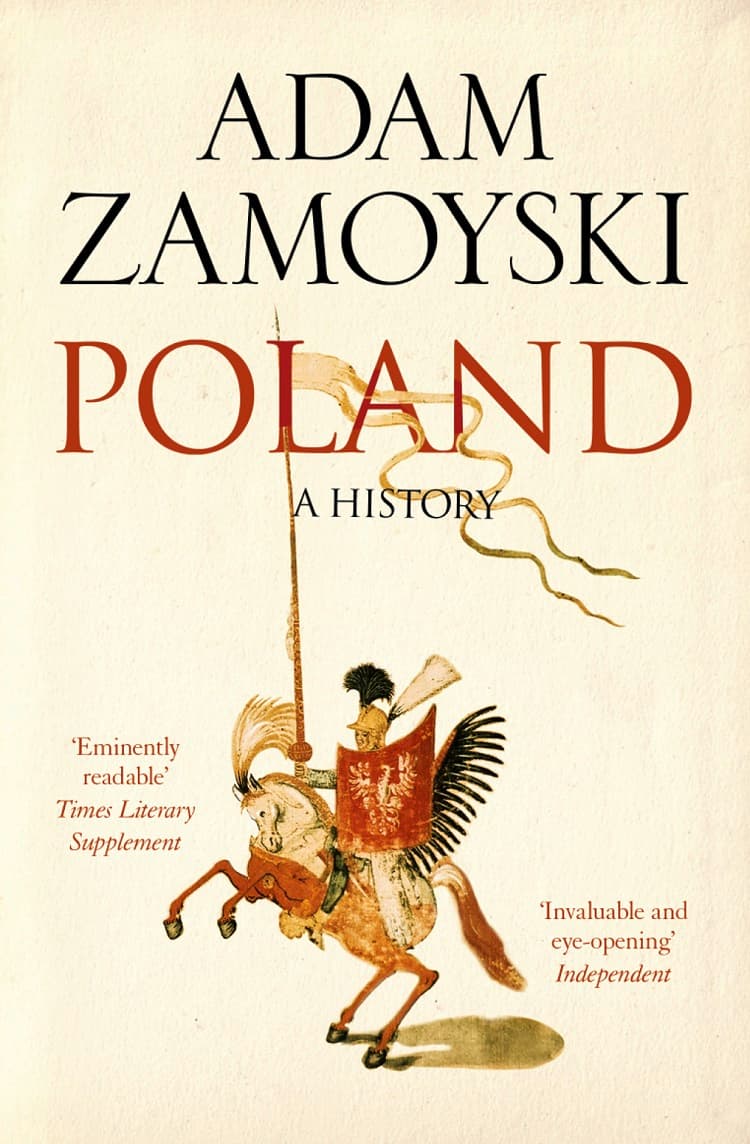
Cover shows detail from a parchment scroll of 1605, showing a member of the Husaria, the Polish winged cavalry
A catalogue record for this book is available from the British Library
All rights reserved under International and Pan-American Copyright Conventions. By payment of the required fees, you have been granted the non-exclusive, non-transferable right to access and read the text of this e-book on-screen. No part of this text may be reproduced, transmitted, down-loaded, decompiled, reverse engineered, or stored in or introduced into any information storage and retrieval system, in any form or by any means, whether electronic or mechanical, now known or hereinafter invented, without the express written permission of HarperCollins e-books.
Ebook Edition © September 2009 ISBN: 978-0-007-32273-2
Version: 2015-12-14
Table of Contents
Cover
Title Page
Copyright
MAPS
TABLES
NOTE ON POLISH PRONUNCIATION
PREFACE
ONE People, Land and Crown
TWO Between East and West
THREE The Jagiellon Experience
FOUR Religion and Politics
FIVE Kingdom and Commonwealth
SIX The Reign of Erasmus
SEVEN Democracy versus Dynasty
EIGHT Champions of God
NINE A Biblical Flood
TEN Morbus Comitialis
ELEVEN The Reign of Anarchy
TWELVE Renewal
THIRTEEN Gentle Revolution
FOURTEEN Armed Struggle
FIFTEEN Insurgency
SIXTEEN The Polish Question
SEVENTEEN Captivity
EIGHTEEN Nation-Building
NINETEEN The Polish Republic
TWENTY War
TWENTY-ONE The Cost of Victory
TWENTY-TWO Trial and Error
TWENTY-THREE Papal Power
TWENTY-FOUR The Third Republic
Index
By The Same Author
About the Publisher
MAPS
Central Europe at the Beginning of the Tenth Century2 The Kingdom of Bolesław the Brave in 10257 The Division of Poland, 113813 The Polish Duchies, c.125022 The Kingdom of Władysław the Short, c.132029 Poland under Kazimierz the Great, 137033 The Combined Kingdom of Poland and Lithuania in 146636 The Jagiellon Dominions at the End of the Fifteenth Century49 The Religious Debate of the Sixteenth Century59 The Polish Commonwealth of 156981 The Commonwealth in the Mid-Seventeenth Century137 The Commonwealth in Decline150 The First Partition of Poland, 1772195 The Three Partitions of Poland212 Napoleonic Europe, 1809223 The Congress Kingdom, 1815-31227 The Lands of Partitioned Poland, c.1860259 The Polish Republic295 The Nazi-Soviet Partition of Poland, 1939317 The People’s Republic of Poland337 Modern Europe383
TABLES
The early Piast kings10 The division and reunification of Poland under the later Piasts24-25 The Jagiellon dynasty of Poland-Lithuania41 The Vasa kings of Poland116
NOTE ON POLISH PRONUNCIATION
Polish words may look complicated, but pronunciation is at least consistent. All vowels are simple and of even length, as in Italian, and their sound is best rendered by the English words ‘sum’ (
Most of the consonants behave in the same way as in English, except for
There are also a number of accented letters and combinations peculiar to Polish, of which the following is a rough list:
ó =
The stress in Polish is consistent, and always falls on the pen—ultimate syllable.
PREFACE
The idea that a historian should radically alter his view of the past over the space of a couple of decades is, on the face of it, preposterous. But when I reread my history of Poland,