
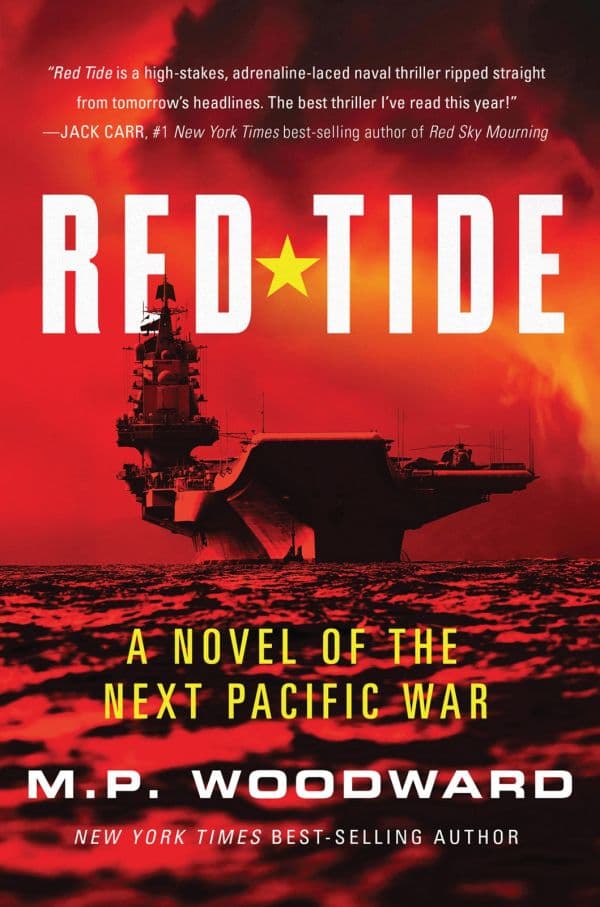
From the New York Times bestselling author behind the Tom Clancy Jack Ryan Jr. books and former U.S. Naval Intelligence officer comes a gripping and timely military thriller.America’s Navy is stretched to the breaking point. China’s combat fleet grows. And both countries compete for access to advanced semiconductor chips produced only in Taiwan. When the Chinese strike first, casualties mount and high-tech arsenals are exhausted. It’s a war of attrition — and the Chinese are winning.Rear Adm. Will Cole outgoing operations officer (N3) of the Pacific Fleet is on the brink of retirement. After a thirty-year career, he’s ready to settle down, rebuild his marriage, and pass the torch to the next generation of the “Fighting Coles”: Their oldest, Henry, flies F-18s. Their middle son, Jamie, is a merchant marine officer. Their daughter, Lucy, has a high-tech job with a defense contractor.But all plans are scrapped when war drums start beating. The Pacific Fleet commander sends Cole stateside to challenge a hardened political bureaucracy into getting serious about the threat to peace in the Pacific. Proven right when the missiles start flying, Cole is ordered to do the impossible: destroy the Chinese fleet and retake Taiwan — before it’s too late. He’ll risk everything in a final fleet amphibious action — his career, his Navy, and his family.With the pacing of a master storyteller and a flair for riveting action sequences, M. P. Woodward captivates readers while raising important questions about the U.S. Navy’s ability to remain the world’s guarantor of a free sea in the twenty-first century.From the halls of Washington to the mountains of Taiwan to the waters of the South Pacific, Red Tide is the story of America at war, as depicted through the eyes of one courageous naval family.
Let China sleep; when she wakes, she will shake the world.
Esteemed Reader,
Before you proceed with the narrative contained herein, I wish to clarify some significant points. While I have tried to present naval units, ranks, and weapons systems accurately, the characters, events, and settings depicted in this work are entirely products of my imagination. They exist solely within the creative confines of this fiction and are not intended to represent, resemble, or portray any real individuals or occurrences. Please also note that for the sake of brevity, I have simplified some high-level command structures.
While fiction often reflects facets of reality, the content of this story remains firmly rooted in artistic invention and speculation.
Respectfully,
M. P. Woodward
Freedom is never more than one generation away from extinction. We didn’t pass it to our children in the bloodstream. It must be fought for, protected, and handed on for them to do the same.
President Reagan’s quote is framed in glass on a large display on the quarterdeck of the USS
May we always remember that the carrier’s namesake, the Battle of Midway, turned the tide of World War II in an unlikely ambush on a superior Japanese task force, a blow from which Japan’s mighty navy would never recover.
Midway was, quite literally, a battle for the ages. Had it gone the other way in those dark days of 1942, America’s Pacific Fleet — already diminished at Pearl Harbor — would have been finished. With the loss of three U.S. Navy carriers, Japan would have taken Midway Island and built a base from which to threaten Hawaii, perhaps even California. The repercussions would have reverberated to the European theater, possibly closing the supply spigot of Lend-Lease that kept Russia and Britain hanging by a thread. An American-led liberation of Europe might never have happened.
Intriguingly, Midway’s historic pivot rested on several hit-or-miss chances: The location of the Japanese task force was based on a triangulation using unproven code-breaking intelligence; one of the three Pacific Fleet carriers,
In the battle’s initial stages, confusion reigned. American squadrons struggled to find the Japanese carriers. When they did, the Navy’s core air tactic — dive bombers flying high to distract enemy fighters while low-flying torpedo planes delivered the knockout blows — reversed itself because of timing errors. Sixty-eight brave men from three torpedo squadrons sacrificed their lives in doomed wave-skimming attacks because they’d arrived too early.
But somehow — through sheer luck, divine Providence, or flat-out grit — the Americans prevailed. It would take three additional years of heart-rending struggle for the Japanese to succumb, but there is little argument among historians that Midway had turned the tide.
Addressing reconstruction at the war’s end, 720 delegates from 44 nations met at Bretton Woods, New Hampshire, in 1945. They agreed that henceforth the world’s oceans should be considered a “commons” available to all nations. Thus, the “Greatest Generation” assumed the mantle of maintaining a worldwide fleet, allies, and base architecture to protect the chokepoints and waterways known to naval professionals as the sea lines of communication.