
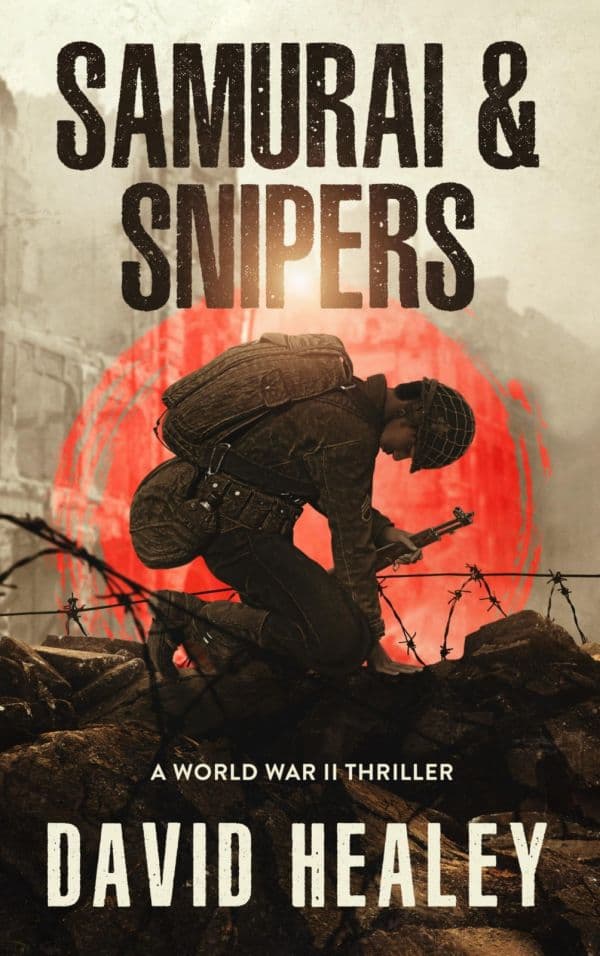
Sniper Deacon Cole finds himself caught up in the Battle of Manila, known as “the Stalingrad of the Pacific.” Deke and the rest of Patrol Easy are soon fighting from street to street and house to house against an enemy that doesn’t know when to call it quits. The sniper duels prove to be every bit as intense as those that took place in the jungle. In the midst of the battle, they are called to help rescue hostages being held by the Japanese. If negotiations fail, Deke figures that he can let his rifle do the talking.
“My country kept the faith. Your capital city, cruelly punished though it be, has regained its rightful place — citadel of democracy in the East.”
Deacon Cole kept a wary eye on the trees, looking for any sign of the enemy. The Japanese troops that had escaped the fall of Ormoc and then Palompon had retreated into the Filipino forest, using the jungle shadows for cover as they picked off the Americans traveling the roads. It never ceased to amaze him how one enemy soldier with a rifle could harass an entire company of infantry. No wonder the enemy was proving so hard to beat.
“You see anything?” Philly whispered beside him.
“Just keep your eyes open,” Deke replied. “They’re in those trees, all right, sure as a hound has fleas.”
He felt an itching between his shoulder blades as if a target had been pinned there. The unrelenting combat was finally getting to him, the constant tension wearing on him like a millstone grinding corn, leaving him feeling thin. He pushed back the brim of the bush hat that he’d gotten from a wounded Australian back on Guam and wiped sweat off his forehead before it dripped into his eyes. A few rivulets of sweat ran like rivers through the rough landscape of scars etching one side of his face and neck.
Deke and Philly were part of Patrol Easy, scouts and snipers whose job it was to escort this convoy and do what they could to discourage Japanese snipers — and not get themselves killed in the process. Patrol Easy was made up of a motley group who never would have come together anywhere but the army, Deke thought.
Though Deke was the best shot of the bunch, they all had their own skills and talents that united their unlikely crew. Philly was a damn good spotter who always had Deke’s back. Rodeo hauled the radio for Lieutenant Steele, who might’ve been the oldest lieutenant in the Pacific. Their Filipino guide was a tough jungle fighter named Danilo. Yoshio was their Nisei interpreter and the most erudite of the bunch, always with his nose in a paperback novel. From time to time, they were joined by Private Egan and his war dog, Thor.
Patrol Easy had been fighting together since Guam and had made the landing at Red Beach, near Palo, in a hailstorm of enemy fire that greeted the American arrival in the Philippines. From there they had been grinding their way across the island of Leyte.
Over the last few weeks, one by one the Americans had cleaned out the enemy’s pillboxes and concrete batteries on Leyte. Most of these fortifications had been built using Filipino slave labor. These fortifications and their defenders gradually had been eliminated — blown up, burned out, or shot to pieces. More than a few GIs and Filipino fighters had died in the process. They had paid dearly for each fortification destroyed.
But it hadn’t been enough. It turned out that for the enemy, the green jungle was the only fortress needed. Now their convoy was making its way through this deadly jungle, the soldiers escorting supply trucks making their way from the coast to the inland towns that the GIs had wrested from the Japanese.
Under different circumstances, the forested hills and sunny open fields would have been a pleasant place to explore. But now, the country that they passed through was littered with signs of war, the worst being the bodies of innocent Filipino civilians who had been murdered by the Japanese. The bodies were mostly those of women or older men, bayoneted or shot at close range.
There was no apparent reason for the killings other than a thirst for violence. These civilians weren’t guerrilla fighters, and they certainly had nothing worth stealing. No, the murders were simply another sign of the enemy’s penchant for cruelty and revenge against the civilian population. If the average GI had been hanging on to some thread of compassion toward his enemy, the sight of those torn and bloody civilian victims had broken it. Any Japanese they captured tended to have a short life expectancy. In contrast, the Americans did everything they could to avoid harming civilians.
For now, the enemy still held the upper hand, firing from cover at the convoy. The GIs fired back, but the enemy remained frustratingly elusive.